Showing posts with label Blues Rock. Show all posts

Tuesday, May 23, 2017

Bob Dylan - Blood On The Tracks (1975)

“Blood On The Tracks” by Bob Dylan (1975)

Release Date: January 17, 1975
Produced by Bob Dylan
Genre: Folk Rock, Classic Rock
Label: Columbia
Chart Positions: #1 (US, Canada, New Zealand), #2 (Norway), #4 (UK, Australia), #5 (Netherlands), #35 (Japan), #45 (Germany), #54 (Ireland)
Certifications: 2xPlatinum (US), Platinum (UK, Canada)

Singles: “Tangled Up In Blue” #31 (US)

Blood on the Tracks is the fifteenth studio album by American singer-songwriter Bob Dylan, released on January 20, 1975 by Columbia Records. The album marked Dylan's return to Columbia Records after a two-album stint with Asylum Records. Dylan began recording the album in New York City in September 1974. In December, shortly before Columbia was due to release the record, Dylan abruptly re-recorded much of the material in a studio in Minneapolis. The final album contains five tracks from New York and five from Minneapolis.


In a 1975 radio discussion with Mary Travers, Bob Dylan stated that “Blood On The Tracks” was a personally painful work. He has claimed it was not autobiographical yet many of the songs seem to mirror what he was experiencing during the break-up of his marriage.

“Blood On The Tracks” is one of Dylan’s best selling albums having reached #1 in the US, Canada and New Zealand. The album reached #2 in Norway as well as #4 in the UK and Australia.

Initially, Dylan considered recording Blood on the Tracks with an electric backing group, and contacted Mike Bloomfield who had played lead guitar on Dylan's Highway 61 Revisited album. When the two met, Dylan ran through the songs he was planning to record, but he played them too quickly for Bloomfield to learn. In the end, Dylan rejected the idea of recording the album with a band, and instead substituted stripped-down acoustic arrangements for all of his songs.

Dylan had finished recording and mixing, and, by November, had cut a test pressing on the album. Columbia began to prepare to release the album before Christmas.

Dylan played the test pressing for his brother, David Zimmerman, who persuaded Dylan the album would not sell because the overall sound was too stark. Robert Christgau also heard the early version of the album and called it "a sellout to the memory of Dylan's pre-electric period". At his brother's urging, Dylan agreed to re-record five of the album's songs in Sound 80 in Minneapolis, with backing musicians recruited by David. The new takes were accomplished in two days at the end of December 1974. Blood on the Tracks was released into stores on January 20, 1975.

While recording the album Dylan kept a tiny notebook in which he worked out lyrics and other aspects of the songs that became the album "Blood On The Tracks." This notebook and others numbering up to around 6,000 pieces have been kept in a secret archive for several decades. He sold this archive for $20 million in 2016.

“Tangled Up In Blue,” the albums only single release, was a minor hit reaching #31 in the US but failed to chart anywhere else. The Telegraph has described the song as "The most dazzling lyric ever written, an abstract narrative of relationships told in an amorphous blend of first and third person, rolling past, present and future together, spilling out in tripping cadences and audacious internal rhymes, ripe with sharply turned images and observations and filled with a painfully desperate longing."

During the song Dylan sings "some are carpenter's wives," which was a reference to Laura Nyro. NYro had been part of the New York music scene in the late 1960s and was very much inspired by Dylan. You may remember some of the hits she wrote such as "Wedding Bell Blues" and "Stoned Soul Picnic" (both hits for The Fifth Dimension), "And When I Die" (Blood Sweat and Tears, "Eli's Coming" (Three Dog Night) and "Stoney End" (Barbra Streisand).

The sixth verse, which begins: "I lived with them on Montague Street," is a direct reference to John Lennon. Lennon had moved into Ringo Starr's Montague Square apartment in 1968 (with Yoko) after Cynthia kicked him out.

Dylan wrote "Tangled Up In Blue" in the summer of 1974 at a farm he had just bought in Minnesota. He had been touring with The Band earlier that year. Dylan sometimes introduced this on stage by saying it took "10 years to live and 2 years to write." Dylan said he wrote this song after spending an entire weekend mesmerized by Joni Mitchell's album "Blue."

"Tangled Up In Blue"

Album highlight “Shelter From The Storm” has been covered by several musicians through the decades. Dylan got the title from a line in Creedence Clearwater Revival's "Who'll Stop The Rain?": "I went down Virginia, seekin' shelter from the storm..."

In his April 1975 review for The New Republic J.T. Lhamon Jr writes, "The last verse of the last song on the album describes how the performer finds his highest art by attending to himself in order to attend to others: 'Life is sad, life is a bust / All you can do is what you must / You do what you must do and you do it well / I do it for you, ah honeybaby, can't you tell?' And that's it right there: that immediate consistent and thorough involvement with an audience both characterizes rock as the primary popular form of our time and determines it's promising esthetic."

Bob Dylan (1975)


BOB DYLAN

Tuesday, May 9, 2017

Led Zeppelin - Houses Of The Holy

“Houses Of The Holy” by Led Zeppelin (1973)

Release Date: March 28, 1973
Produced by Jimmy Page
Genre: Hard Rock, Heavy Metal, Blues Rock
Label: Atlantic

Chart Positions: #1 (US, UK, Canada, Australia), #3 (Austria, Netherlands, Japan), #4 (Norway), #8 (Germany), #9 (New Zealand, Spain), #11 (Finland), #12 (Portugal), #15 (Sweden), #17 (Italy), #20 (Switzerland, Belgium), #24 (Denmark), #29 (France)
Certifications: 11xPlatinum (US), Platinum (UK, France), Gold (Germany, Argentina, Spain)

Singles: “Over The Hills and Far Away” #51 (US), #63 (Canada), “D’yer Mak’er” #20 (US), #2 (France), #7 (Canada, Poland)

One of the most iconic record covers of the 1970s is Led Zeppelin’s fifth album, Houses of the Holy, released on 28 March 1973 by Atlantic Records. It is their first album composed of entirely original material and it represents a turning point in musical direction for the band, who had begun to record songs with more layering and production techniques.


This was Led Zeppelin's final studio release on Atlantic Records before forming their own label, Swan Song Records, in 1974. It was also the only Led Zeppelin album that contained complete printed lyrics for each song. Although intended for release in January 1973, delays in producing the album cover meant that it was not released until March, when the band was on its 1973 European tour. They had trouble designing and printing the unique album cover by the artistic company Hipgnosis, with the band completely rejecting the initial artwork and the first prints of the final artwork accidentally coming out with a strong purple tint. When they finally got the artwork correct, the album was banned from sale in many locations because of the naked children on the cover who pay homage to the Arthur C. Clarke novel Childhood’s End. The album was nominated for a Grammy Award in the category of best album package.

The Houses of the Holy album cover was not a small army of naked children with wigs on, it was only two kids, a brother and sister, who were photographed over the course of ten days at dawn and at dusk. One of them went on to become a world famous TV presenter, Stefan Gates, of the BBC’s popular Cooking in the Danger Zone show.

Gates, who was five at the time said in an interview years later, “For the Zeppelin cover we went to Ireland during the Troubles. I remember arriving at the airport and seeing all these people with guns. We stayed in this little guest house near the Giant’s Causeway and to capture the so-called magic light of dawn and dusk we’d shoot first thing in the morning and at night. I’ve heard people saying they put wigs on several children. But there was only me and my sister and that’s our real hair. I used to love being naked when I was that age so I didn’t mind. I’d whip off my clothes at the drop of a hat and run around having a great time, so I was in my element. My sister was older so she was probably a bit more self-conscious.”

Produced by guitarist Jimmy Page (like all Zeppelin albums), the album featured sophisticated layered guitars, the addition of obscure instrumentation, and other rich production techniques. The album featured styles and sub-genres not heard on previous Led Zeppelin albums, such as funk, reggae, and doo-wop. The album is an indirect tribute to their fan base, who were showing up in record numbers to their live shows.  It perfectly straddles the bands early, more blues-based period from their later work, which consisted of more richly produced studio albums that tilted more towards pop and modern rock. Bass player and keyboardist John Paul Jones temporarily left the band for a few days during this album’s recording but soon returned and stayed with the band until the end.

There were also several recorded songs not included on Houses of the Holy but released on later albums such as Physical Graffiti and Coda. “Physical Graffiti” contained the songs “The Rover,” “Houses of the Holy” and “Black Country Woman.” While “Coda” contained “Walter’s Walk.”

In 1976 Led Zeppelin released their first live album named “The Song Remains The Same” the opening track of “Houses of the Holy.” Prior to the album's sessions the song had been rehearsed with the working title "Worcester and Plumpton Races," which was a reference to Page and Plant's homes. Successive titles were "The Overture" and "The Campaign." Finally as Plant was fine tuning the lyrics the title "The Song Remains The Same" was born.

"The Rain Song" was written in response to a conversation Jimmy Page had with George Harrison. Harrison asked Page why Led Zeppelin had never recorded any ballads.

The first single release “Over The Hills and Far Away” was a moderate hit in North America reaching #51 in the US and #63 in Canada. This evolved from the Yardbirds song "White Summer," an acoustic solo by Jimmy Page. Many of the same riffs and chords are in it. After The Yardbirds broke up, Led Zeppelin continued to play "White Summer" live. Jimmy Page and Robert Plant originally constructed the song in 1970 at Bron-Yr-Aur, a small cottage in Wales where they stayed after completing a gruelling North American concert tour. The song was first called "Many, Many Times", as shown on a picture of the original master on the Led Zeppelin website.

"D'yer Mak'er" (1973)

The second single “D’yer Mak’er” did better on the charts reaching US #20, #2 in France and #7 in both Poland and Canada. The title is a play on the word "Jamaica" when spoken in a British accent. The name of the song is derived from an old joke, where two friends have the following exchange: "My wife's gone to the West Indies." "Jamaica?" (which has a similar pronunciation as "D'you make her?") "No, she wanted to go". This song was meant to imitate reggae and its "dub" derivative emerging from Jamaica in the early 1970s. Its genesis is traced to Led Zeppelin's rehearsals at Stargroves in 1972, when drummer John Bonham started with a beat similar to 1950s doo-wop, and then twisted it into a slight off beat tempo, upon which a reggae influence emerged. The distinctive drum sound was created by placing three microphones a good distance away from Bonham's drums. Led Zeppelin had a curious history of single releases in America. While the band was active, they released just 10 singles, which typically did just well enough to get a mention from Casey Kasem on American Top 40. "D'yer Mak'er" was one of those singles (backed with "The Crunge"), peaking at #20. Zeppelin was never a "singles band," so these releases were intended to drive sales of the albums, which they did. They often sold well enough to make the charts, however, leaving poor Mr. Kasem to wonder how to pronounce the title to this one.

The third single “The Ocean” was released only in Germany and Austria and charted only in Germany at #8. "The Ocean" refers to the sea of fans seen from the stage at Led Zeppelin concerts, to whom this song was dedicated. The voice on the intro is drummer John Bonham. When he says, "We've done four already, but now we're steady and then they went, 1... 2... 3... 4...," he is referring to the takes. They had tried to record it 4 times prior but couldn't get it right, so as a pep talk he said his famous line. In the last line, the "Girl who won my heart" is Robert Plant's daughter Carmen, who was 3 years old at the time.

The album is filled with highlight after highlight, “The Crunge” is a funk tribute to Wilson Pickett, Otis Redding and James Brown and evolved out of a jam session built around Bonham’s off-beat drums and a bass riff by Jones. This song was used as the b-side to the single “D’yer Mak’er.” “Dancing Days” used as the b-side to “Over The Hills and Far Away” was the closest that Led Zeppelin ever came to writing a pop song. It was inspired by an Indian tune that Jimmy Page and Robert Plant heard while traveling in Bombay.

"Houses of the Holy (1973) Inside Gatefold Artwork

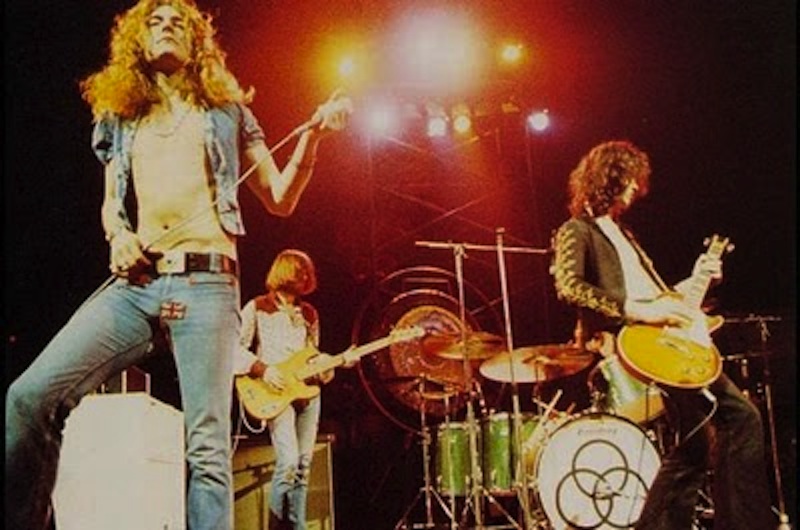
Led Zeppelin (1973)


LED ZEPPELIN

Saturday, April 22, 2017

Bonnie Raitt - Give It Up (1972)

“Give It Up” by Bonnie Raitt (1972)

Release Date: September 1972
Produced by Michael Cuscuna
Chart Positions: #138 (US)
Certifications: Gold (US)
Singles: “Too Long At The Fair”

“Give It Up” was the second album release for the 22-year-old Bonnie Raitt. Her first album, a straight up blues affair titled “Bonnie Raitt,” released in 1971 failed to chart but managed to capture the attention of several music luminaries of the time.


Transitioning to her second album Raitt strengthened her recognizable style. When she went into the studio to record “Give It Up” Raitt had a new advantage from the attention she garnered with her first album. She hired producer Michael Cuscuna, a musician with a strong background in jazz. Along with recording Bonnie Raitt, Cuscuna’s also produced several albums throughout the 70s for jazz musician Dave Brubeck. Cuscuna’s brought in notable musicians such as Paul Butterfield (Butterfield Blues Band), Eric Kaz (songwriter of “Love Has No Pride” and several other hits), and Dave Holland (prolific jazz musician).

“Give It Up” maintained Raitt’s R&B and blues background melding it with a contemporary Californian soft-rock and folk sound.

“Too Long At The Fair” was released as a promo single in the US, Canada and the UK to promote the album. Early in the 1970s Bonnie Raitt's manager, Dick Waterman, dropped into Passim (Club 47) in Cambridge, attempting to get a booking for Raitt. While Waterman and the club owner were discussing the booking, he heard Joel Zoss sing "Too Long at the Fair." After the show Waterman introduced himself and asked for a tape of the song to play for Raitt. Raitt recorded the song along with another Zoss composition “I Gave My Love A Candle” which appeared on her 1973 album “Takin’ My Time.”

The title track, “Give It Up or Let Me Go,” written by Bonnie Raitt, opens with Raiit’s blues filled acoustic guitar and quickly works into a New Orleans Dixieleand Jazz celebration.

"Give It Up Or Let Me Go"

Eric Kaz’s “Love Has No Pride” closes the album. Raitt’s somber folksy blues rendition gave life to a song which was recorded a year later by Linda Ronstadt for her 1973 album “Don’t Cry Now.” Ronstadt released the song as a single and achieved minor chart success with it.


BONNIE RAITT

Thursday, April 13, 2017

Robin Trower - Bridge of Sighs (1974)

“Bridge Of Sighs” by Robin Trower (1974)
Release Date: April 20, 1974
Produced by Matthew Fisher
Chart Positions: #1 (UK, Australia, Canada, Norway, New Zealand, Sweden), #2 (US), #5 (Netherlands), #23 (Japan), #29 (Germany)
Certifications: Gold (US) Silver (UK)
Singles: “Too Rolling Stoned”
Label: Chrysalis

Bridge of Sighs is the second solo album by the English guitarist and songwriter Robin Trower. It was released in 1974. Bridge of Sighs, his second album after leaving Procol Harum, was a breakthrough album for Trower. Songs from this album, such as "Bridge of Sighs", "Too Rolling Stoned", "Day of the Eagle", and "Little Bit of Sympathy", have become live concert staples for Trower.
The album was produced by organist Matthew Fisher, formerly Trower's bandmate in Procol Harum. Acclaimed Beatles engineer Geoff Emerick was this album's sound engineer.


In an interview with Guitar World, Robin Trower explained how the album got its title. Robin said that he had had the first line of the song for years and then one day he saw some sport pages which listed a racehorse called Bridge of Sighs and thought that would be a great title.

Bridge of Sighs (Chrysalis 1057) reached #7 in the UK during a chart stay of 31 weeks. It was certified Gold on 10 September 1974. Early printings of the original album cover had the front image upside-down, and were more greenish in colour.

“Bridge of Sighs” is Robin Trower’s career watermark. It is his highest charting UK album. “Bridge of Sighs” was a throwback to the ’60s. Even if it was behind the times, the Cream and Jimi Hendrix inspiration resonates, particularly on the LP bookends, “Day of the Eagle” and “Little Bit of Sympathy,” and “Lady Love,” which is reminiscent of Free.

Even the liquid dreamscapes conveyed by the brilliantly languid title track and “In this Place” seem to hearken back to the previous decade, which quite possibly explained why they connected deeply with listeners still mourning for the quickly fading, unfulfilled promises of the Summer of Love. As such, just as the real Bridge of Sighs, located in Venice, Italy, had once transported medieval convicts from court to gallows, Trower’s masterwork carried the musical ghosts of the ‘60s into the new decade, before paying them a teary goodbye forever.

“Too Rolling Stoned” was the only single release from the album. The song failed to chart but has become a favorite of Trower fans.

"Too Rolling Stoned"


Robin Trower (1974)


ROBIN TROWER